


The Winter Emergency Wound Care Teams Don't Prepare For: Carbon Monoxide Poisoning and Your Regional HBOT Capacity
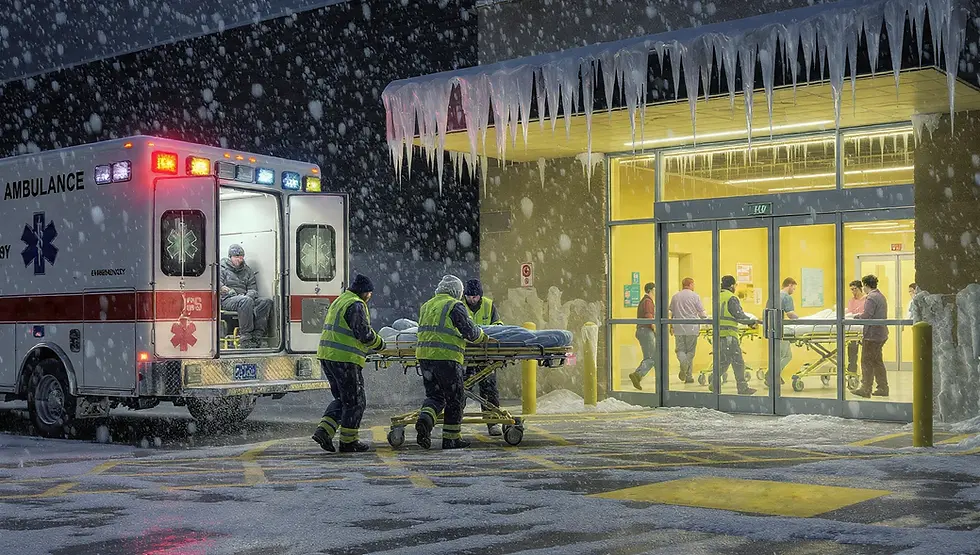
It’s 2:00 a.m. on a Saturday in February. An ice storm has left much of your region without power for 24 hours. Outside, the temperature is holding at 18 degrees.
The first EMS dispatch comes in quietly: A family of four. A portable generator was running in an attached garage—"just for a few hours," the father told the 911 operator. By the time paramedics arrived, he was unconscious.
Twenty minutes later, another call. An elderly woman is found confused and vomiting in her apartment. Her furnace failed days ago; she’s been using a gas oven for supplemental heat. Before dawn, three more patients arrive at your facility with the same constellation of symptoms: headache, nausea, and altered mental status.
In this scenario, your wound care program is no longer just a specialty clinic for diabetic foot ulcers or delayed radiation injury. Your Hyperbaric Oxygen Therapy (HBOT) chamber has become critical regional emergency infrastructure.
When winter storms drive desperate heating decisions, carbon monoxide (CO) poisoning cases don't wait for morning rounds. The question isn't whether these cases will arrive—it's whether your HBOT operational protocols are ready for a multi-patient surge.
The Pattern You're Not Tracking: Why Winter CO Surges are Predictable
Each year, more than 50,000 Americans visit emergency departments due to accidental carbon monoxide poisoning. These aren’t random incidents; they follow a precise seasonal trajectory that aligns with dropping temperatures and regional power grid failures.
As a colorless, odorless byproduct of incomplete combustion, CO becomes a "silent killer" during winter months due to a convergence of three high-risk variables:
1. The "Cold Snap" Mechanical Failure
Furnaces running 24/7 during deep freezes expose hidden vulnerabilities. Small cracks in heat exchangers or blocked flues—unnoticed in the fall—become lethal by January. Programs must recognize that HVAC maintenance trends in their service area directly correlate with emergency HBOT demand.
2. Desperation-Driven Heating Choices
Extended power outages during ice storms drive homeowners to make split-second, dangerous decisions. When the temperature indoors hits 40 degrees, portable generators are often moved into garages or basements "just for a few minutes." According to the Consumer Product Safety Commission (CPSC), generator misuse is a leading cause of winter CO fatalities.
3. Socioeconomic Vulnerability and Fixed Incomes
The "Preparedness Gap" is often a financial gap. For an elderly patient on a fixed income, a $1,200 furnace repair isn't an option. Using a gas oven for supplemental heat or a kerosene heater in a poorly ventilated room becomes a survival tactic.
Identifying High-Risk Populations
According to the CDC’s Carbon Monoxide clinical guidelines, the most vulnerable patients include:
Infants and the Elderly: Higher sensitivity to oxygen deprivation.
Individuals with Comorbidities: Chronic heart disease, anemia, or respiratory conditions.
The "Sleeping" Victim: Those who are sleeping or intoxicated may never experience the "flu-like" warning symptoms (headache, nausea, fatigue) before reaching lethal levels.
SHS Insight: We help wound care programs move beyond chronic patient demographics to track seasonal emergency patterns. Winter CO surges aren't random—they are predictable events. Understanding your regional risk factors (from ice storm frequency to local socioeconomic pressures) is the first step toward building an operational infrastructure that holds under pressure.
Why HBOT Matters for Carbon Monoxide Poisoning: The Clinical Urgency
Carbon monoxide (CO) doesn't just reduce oxygen delivery—it actively blocks it. CO binds to hemoglobin with an affinity 200 to 240 times greater than oxygen, creating carboxyhemoglobin (COHb) which starves the brain, heart, and skeletal muscles.
The Half-Life Math: Why Every Minute Counts
The primary goal of Hyperbaric Oxygen Therapy (HBOT) is the rapid dissociation of CO from hemoglobin. The impact on the CO half-life is dramatic:
Treatment Environment | CO Half-Life (Approx.) | Speed Increase |
Room Air (21% O2) | 320 Minutes (5.3 hours) | Baseline |
100% Oxygen (Non-rebreather) | 90 Minutes (1.5 hours) | ~3.5x Faster |
HBOT @ 3 ATA | 23 Minutes | 14x Faster |
HBOT eliminates carbon monoxide 14 times faster than room air. When brain tissue is oxygen-starved, this isn't just an incremental improvement—it is the margin between full recovery and permanent neurological sequelae.
The Clinical Challenge: When Symptoms Don't Match Severity
The insidious nature of CO poisoning lies in its "mimicry." Early exposure mirrors common winter illnesses like the flu. However, the American Lung Association warns that even low-level chronic exposure can cause permanent brain and cardiac injury.
Key Diagnostic Note: COHb levels alone do not always predict outcomes. A patient with "low" levels may present with severe neurological deficits, while another with high levels may appear stable. This makes UHMS-approved protocols essential for standardized care.
UHMS Treatment Protocols and Clinical Decision Points
According to established clinical guidelines for acute carbon monoxide intoxication, the regimen typically follows:
Primary Treatment: 3.0 ATA for 30 minutes, followed by 2.5 ATA for 60 minutes (including air breaks).
Sequential Treatment: If symptoms persist, additional sessions may occur within 4–8 hours, continuing 1–2 times daily.
Utilization Review: Mandatory after the 5th treatment session.
Criteria for Emergent HBOT:
Loss of consciousness or altered mental status.
Pregnancy (Fetal hemoglobin has an even higher affinity for CO).
Evidence of cardiac ischemia or abnormal psychometric evaluation.
HbCO levels >15% that remain unchanged by normobaric oxygen.
Healthcare System Impact: The True Cost of Delayed Treatment
The cost of HBOT is modest compared to the long-term expense of permanent neurological injury. By preventing delayed sequelae—such as memory loss, personality changes, and movement disorders—timely intervention delivers measurable value to the regional healthcare infrastructure.
SHS Insight: We equip wound care teams with clinical protocols that match the urgency of carbon monoxide poisoning timelines. When every minute of COHb clearance matters, operational readiness isn't optional—it's what determines whether your regional HBOT infrastructure functions under pressure or fails when capacity is tested.
The Operational Reality: Managing Multi-Patient CO Surges
Ice storms are not isolated events; they are regional crises. When a power grid fails, dozens of families make the same high-risk heating decisions simultaneously. For your facility, this means carbon monoxide (CO) cases don't arrive as scheduled appointments—they arrive as clusters.
It's 3:15 AM. Your on-call technician gets the first call from the ED: family of four, generator in garage, father unconscious. Treatment starts at 3:45 AM—3.0 ATA for 30 minutes, then 2.5 ATA for 60 minutes. Air breaks at intervals.
At 4:20 AM, while the first patient is still in the chamber, EMS calls again: elderly woman, gas oven heating, altered mental status. At 4:50 AM: another call. Pregnant patient, 28 weeks, exposure timeline unclear but symptomatic.
By 5:00 AM, you have three patients who need hyperbaric oxygen therapy. One is mid-treatment. Two are waiting. If you have a multiplace chamber, your physician has been in the chamber with the first patient and needs decompression time before the next dive. Your technical staff is running on a single overnight shift.
This is when you discover whether you have protocols—or whether you're building them in real-time.
Your program may be built for chronic wound management, but in a winter surge, you must decide whether or not to function as critical emergency infrastructure.
Capacity Planning: The 3:00 AM Triage Checklist
The pregnant patient is stable but symptomatic. The elderly woman is confused and vomiting. The first patient is completing treatment. Who goes next?
Your technician is looking at you for guidance. EMS is asking if you can accept a fourth patient from a different incident. The ED physician wants to know your current wait time. And you realize your triage protocol was written for scheduled wound care appointments, not emergent multi-patient CO exposure.
When multiple patients present at once, your operational architecture is tested. Most programs haven’t answered these four critical questions:
Chamber Sequencing: In a monoplace facility, how do you prioritize? Using UHMS clinical criteria (loss of consciousness, pregnancy, or cardiac ischemia) is essential for rapid triage.
Physician Decompression Safety: If your facility has a multiplace chamber and your on-call physician oversees a 3.0 ATA dive at 2:30 AM, and more patients arrive at 4:00 AM, are they cleared for immediate re-entry? Your Policy & Procedure (P&P) manual must define these safety parameters.
Staffing Call-Backs: Do you have a "Surge Protocol" for technical staff? Treating multiple CO patients overnight often requires backup CHT-certified personnel to prevent burnout and ensure safety.
EMS Real-Time Coordination: During "Winter Storm Fern" or similar regional events, area EMS need to know your current capacity. Established communication channels prevent critical delays in patient transport.
Documentation & Compliance Under Pressure
Emergency volume doesn’t excuse documentation requirements. To ensure Medicare reimbursement (HCPCS G0277) and clinical safety, every surge case must include:
ABG and HbCO Results: Captured immediately upon arrival.
Sequential Treatment Logs: Precise timing for the 3.0 ATA and 2.5 ATA phases.
Utilization Review: Mandatory after the 5th treatment session to justify medical necessity for ongoing neurological sequelae.
The "Winter Work-Up" Protocol
While urgency is paramount, a standardized work-up ensures no comorbidities are missed. If time and the patient's condition allow, the protocol should include:
EKG and Troponin Levels: Essential for checking cardiac strain.
Pregnancy Testing: CO is a mandatory HBOT indication for pregnant patients regardless of their carboxyhemoglobin levels.
Neurological/Psychometric Evaluation: To establish a baseline for potential delayed sequelae.
The Preparedness Gap: Chronic Efficiency vs. Winter Demands
Walk into any high-performing wound care center and you’ll see masterclass protocols for "bread-and-butter" operations. From diabetic foot ulcer (DFU) management and delayed radiation injury to problem grafts and flaps, these programs have spent years perfecting scheduled, predictable care.
But when an ice storm hits, the mission shifts from a specialty clinic to critical emergency infrastructure. Most programs have a "Preparedness Gap" where their chronic care design fails to meet regional emergency demands.
Identifying the Missing Operational Architecture
It’s not negligence—it’s a misalignment of design. To ensure your program holds under pressure, you must address these five core blindspots:
Staff Competency Beyond the "Business Day": Your technicians are experts at 20-session chronic care plans. But can they execute a 3.0 ATA to 2.5 ATA emergency protocol with air breaks at 4:00 a.m.?
The Triage Framework: Your intake is optimized for insurance verification and referrals. It is not designed to answer: "We have three patients: one unconscious, one pregnant, and one with cardiac distress. Who goes in the chamber first?"
On-Call Physician and Staff Decompression: Routine after-hours questions are one thing; overseeing back-to-back emergency dives is another. Your Policy and Procedure (P&P) manual must include specific safety parameters for physician and staff re-entry into a multiplace chamber.
EMS Coordination: Does your local EMS know your exact HBOT capacity? Without established communication channels, patient transport becomes a bottleneck during regional crises.
Rapid Documentation Templates: When managing acute patients in rapid succession, your EHR must support immediate capture of ABG results, HbCO levels, and air break intervals without the friction of a standard chronic care intake process.
The Limits of Prevention Architecture
Organizations like the American Lung Association and CDC have clear guidelines: detectors on every floor, annual furnace inspections, and 20-foot generator clearances.
However, prevention has a socio-economic ceiling.
The elderly patient on a fixed income cannot afford a $1,200 furnace repair.
Rural families in a five-day blackout have few heating alternatives.
Vulnerable populations often have no choice but to take risks.
Your HBOT program exists for the moment prevention fails. The operational question is: Are you prepared for when those limits are reached?
SHS Insight: We don't just help programs respond to emergencies—we help them prepare before the ice storm hits. From protocol development to staff training to capacity planning, we build infrastructure that holds under pressure. Most wound care teams discover their preparedness gaps during their first winter surge. We help you find them beforehand, when there's still time to build the architecture that matters.
Building Your Winter CO Emergency Protocol: The Operational Checklist
You’ve identified the pattern and the preparedness gap. Now, what does a functional, surge-ready protocol actually look like? A resilient winter CO response plan must bridge the gap between clinical theory and 4:00 AM reality.
Clinical Architecture: The Foundation
Staff need clear, laminated decision trees at every intake station. Your UHMS-aligned protocol should include:
HBOT Triage Criteria: Immediate consideration for patients with Loss of Consciousness (LOC), pregnancy (regardless of level), cardiac ischemia, or HbCO levels >15%.
Standardized "Acuity" Work-Up: A rapid-capture pathway for ABGs, carboxyhemoglobin (HbCO), EKG with troponin, and pregnancy testing.
The Sequential Decision Framework: If symptoms persist after the initial 3.0 ATA to 2.5 ATA dive, your protocol must define the 4–8 hour reassessment window and the mandatory 5th-treatment utilization review trigger.
Operational Architecture: Surge Execution
When three patients arrive at once, the clinical criteria tell you who to treat, but the operational protocol tells you how:
Chamber Sequencing & Physician Safety: Define decompression requirements for on-call physicians and staff overseeing back-to-back dives in a multipace chamber.
Technical Staff Surge: Establish "Call-Back" triggers for CHT-certified staff when volume exceeds scheduled on-call capacity.
Emergency Billing (ICD-10 T58.XXX): Use rapid-capture documentation templates specifically for acute CO exposure to bypass the "friction" of chronic care EHR templates.
EMS Direct-Line Coordination: Provide real-time capacity updates to regional dispatchers to manage patient flow during peak storm events.
Staff Training: Beyond Chronic Care
Expertise in 20-session chronic wound care plans doesn't automatically translate to emergency competence. Training must focus on:
High-Pressure Execution: Can the overnight shift run the 3.0 ATA protocol independently?
Triage Support: Recognizing pregnancy as an absolute indicator and identifying signs of acute cardiac compromise.
Communication Standards: Streamlined reporting between technical staff, ED personnel, and on-call physicians.
The Community Integration Question: Bridging the SDoH Gap
Some wound care programs extend their preparedness beyond facility walls by addressing Social Determinants of Health (SDoH)—the non-medical factors that often dictate emergency outcomes.
Winter Storm Safety Seminars: Hosted annually to educate high-risk neighborhoods on safe heating.
CO Detector Distribution: Coordinated with local fire departments to get sensors into low-income households.
Targeted Outreach: Educational materials tailored for non-English speakers and elderly residents on fixed incomes.
SDoH Screening as Strategic Intelligence: While CMS has shifted away from mandatory reporting requirements, leading programs are adopting standardized screening tools for housing instability, utility difficulties, and transportation needs—not for compliance, but for operational planning.
The Reality: These initiatives don't just "do good"—they provide the critical data needed to predict which neighborhoods will surge during the next ice storm. However, even perfect community education won't eliminate winter CO cases. Your protocol must assume prevention has a socioeconomic ceiling, and your facility must be ready when that ceiling is reached.
SHS Insight: We've supported HBOT programs for 25+ years. We help you build the operational architecture that holds—from clinical triage to community-level SDoH integration. When winter emergencies test your capacity, we ensure you have the infrastructure that holds.
Conclusion: Building the Architecture That Holds
Winter carbon monoxide poisoning isn’t a "maybe" scenario for your wound care program; it’s a predictable seasonal pattern. The question isn't whether CO patients will arrive at your facility this winter—it's whether your program is prepared for a surge when they do.
Most programs build their infrastructure around chronic conditions. That works for your daily "bread-and-butter" patients, but when an ice storm knocks out regional power, your HBOT chamber stops being a specialty service and becomes critical emergency infrastructure.
The "Preparedness Gap" isn't about clinical competence—your team knows how to deliver hyperbaric oxygen. The gap is operational. You can build that infrastructure now, or you can try to improvise it at 3:00 a.m. when multiple patients are arriving and the pressure is on.
Why Partners Choose Shared Health Services (SHS)
With over 25 years of experience, we help you build the architecture that holds under pressure:
Ready-to-Execute Triage: Clinical criteria your staff can execute at 4:00 a.m. without hesitation.
Surge Planning: Real-world protocols for physician and staff decompression and technical staff capacity.
Regional Integration: Positioning your facility as a known resource for local EMS and emergency departments.
Emergency-Optimized Documentation: Templates built for speed and compliance, not just scheduled appointments.
When winter storms test your capacity, your operational architecture will either hold or break. We help you build the one that holds.
Contact Shared Health Services Today
Phone: (800) 474-0202
Website: www.sharedhealthservices.com


